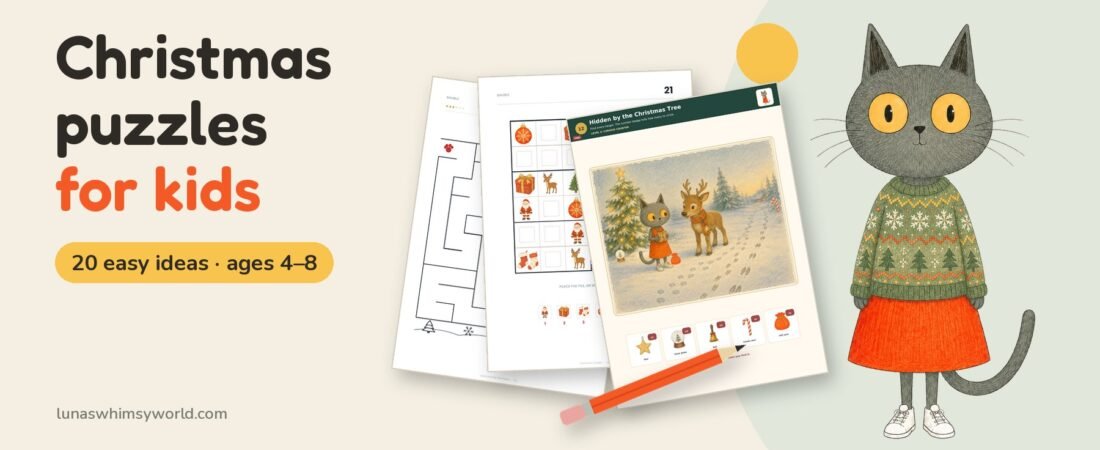
The best Christmas puzzles for kids aged 4 to 8 are short, picture-based and easy to pause: mazes, picture sudoku, look-and-find scenes and simple puzzles made from old Christmas cards. Mix a few that need nothing, a few printed pages and one or two homemade ones, and December has a quiet activity for every wait.
December is a month of waiting. Waiting for the car to reach Grandma’s, waiting for dinner while the grown-ups cook, waiting for Christmas Eve to finally end. Christmas puzzles for kids fill those gaps well, because a puzzle has a clear start and a satisfying finish, and it asks a child to slow down instead of speed up.
This guide has twenty ideas: six that need nothing at all, six printable ones, six you can make from things already in the house, and two simple December routines. None of them needs reading, and every one of them can stop when the doorbell rings.
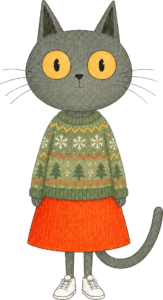
Luna’s Christmas books star a small grey cat based on a real one. When I moved back to the Hungarian countryside, a shy, all-grey mother cat came into our garden with a family of cats and stayed with us for the rest of her life. In the books she is still a little shy. In Luna and the First Snow, the story in the Christmas maze book, she sets off for a winter supper with nothing to bring, and finds that the help she gives on the way is a gift too.
Key takeaways
- Start with puzzles that need nothing: counting lights and spotting the missing bauble work anywhere.
- Picture-based puzzles suit ages 4 to 8 because nobody has to read the instructions.
- One page a day is a gentle rhythm for December; a whole book in one afternoon is a lot.
- Old Christmas cards make free homemade puzzles: jigsaws, halves to match, picture clues.
- Keep the answer keys with you, and a slightly easier puzzle for the tired evenings.
In this article
What makes good Christmas puzzles for kids 4–8?
Christmas is already exciting. The best puzzles for this month add a little calm rather than more noise. Here are six things to look for.
| Look for | Why it helps in December |
|---|---|
| Pictures, not words | Children aged 4 to 6 can start alone, and older children can help younger ones. |
| One page, one finish | A short puzzle fits between the busy parts of the day. |
| Stops in one move | Visitors arrive, dinner is ready, the car stops: fold the page and go. |
| Festive but calm | Snow, stars and mittens, not flashing lights and countdown pressure. |
| Prints in greyscale | December printing adds up; black line art saves colour ink. |
| Comes with answers | You can check a tricky maze without solving it yourself first. |
Christmas puzzles for kids that need nothing at all
These six puzzles use what is already around you: the tree, the presents, the jumpers. They are perfect for the first ten minutes of a wait.
1. Count the lights
Choose one colour of light on the tree, or one row of lights in a window, and count them together. Younger children count up to ten and start again; older children can count one colour and then guess whether there are more of another.
2. What’s missing from the tree?
Your child looks at the lower branches of the tree for a minute, then turns around. You quietly take off one decoration. They turn back and find what is missing. Use unbreakable decorations for this game, and let them have a turn hiding one for you.
3. Odd decoration out
Line up three decorations, two that belong together and one that does not: two stars and a bell, two red baubles and a green one. Your child spots the odd one out and explains why. There is often more than one good answer, which is half the fun.
4. Christmas riddles
Riddles are puzzles you can carry in your head. Here are four to start with:
- I am green all year, and in December I wear lights. What am I? (A Christmas tree.)
- I come in a pair, I have no feet, and I keep your fingers warm. What am I? (Mittens.)
- I fall from the sky, I am white and cold, and I melt on your nose. What am I? (A snowflake.)
- I hang on a branch, I am round and shiny, and I do not like being dropped. What am I? (A bauble.)
Then let your child invent one for you. Their riddles will not always work, and that is the best part.
5. Present line-up
Put four or five wrapped presents in a row and ask your child to sort them: smallest to biggest, lightest to heaviest, or by colour of paper. Weighing presents with two hands is a puzzle every child takes seriously.
6. Pattern spotting
Christmas jumpers and wrapping paper are full of repeating patterns: star, tree, star, tree. Find one together and ask, “What comes next?” Children aged 6 to 8 can look for patterns with three parts.
Printable Christmas puzzles for kids
Printed pages are the heart of quiet Christmas puzzles for kids. They come out of a bag at the right moment, they suit a car seat or a kitchen table, and they leave you with something finished to stick on the fridge.
7. Christmas mazes
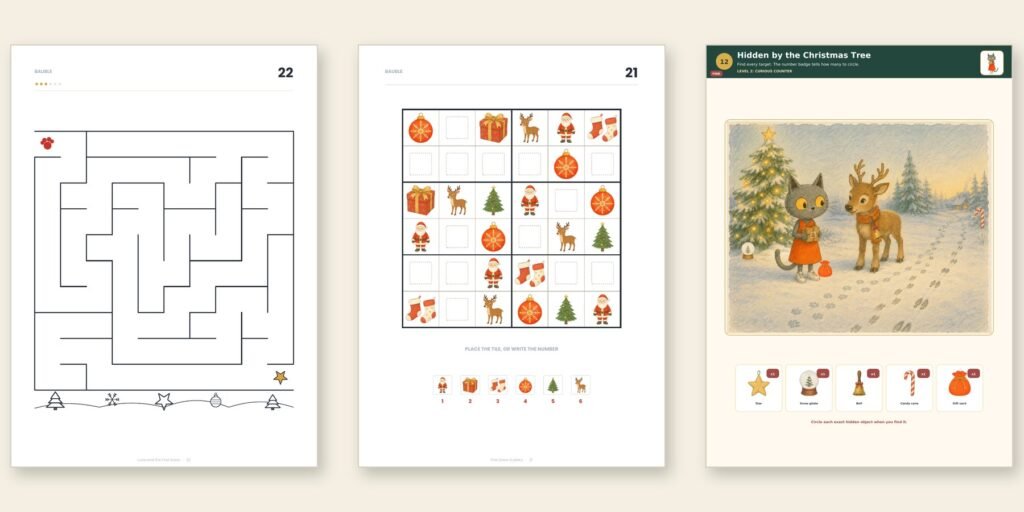
A maze is the classic quiet puzzle. Start at the paw print, find the way to the star. Small grids such as 6×6 or 8×8 suit 4- and 5-year-olds; children aged 7 and 8 enjoy the big 15×15 and 18×18 mazes, especially if they can race the clock against a grown-up.
8. Christmas picture sudoku
Picture sudoku uses Christmas pictures instead of numbers. Each row, each column and each box gets every picture once. Start with a 4×4 grid; once that feels easy, 6×6 grids are the next step. Children can cut out picture tiles or write the matching number in each square.
9. Hidden-object scenes
Look-and-find pages give your child a painted winter scene and a row of small pictures to find in it. A good page also says how many of each to find, so your child keeps looking after the first one. These are lovely to share on the sofa, one finder each.
10. Counting pages
A counting page asks a child to count three kinds of things in one picture: snowflakes, mittens, reindeer. Then comes the tricky bit: which group has the most? It is a puzzle and a counting practice in one, and it needs no reading.
11. A picture-code message
Draw a small key: a star means L, a bell means U, a tree means N, a mitten means A. Then write a message in pictures: star, bell, tree, mitten. Your child decodes it: LUNA. Children aged 7 and 8 can write a secret message back to you. For 4- and 5-year-olds, the code can be colours instead of letters.
12. A dot-to-dot star you make yourself
Draw a star or a Christmas tree lightly in pencil, put a dot on every corner, and number the dots. Rub out the outline. Your child joins the dots in order and the shape appears. Older children love making one for a younger sibling.
Homemade Christmas puzzles from things you already have
Some of the nicest Christmas puzzles for kids cost nothing. Old cards, cookie cutters and the sock drawer are full of them.
Adult supervision recommended; small parts and scissors are for grown-up hands with children under 3.
13. Christmas card jigsaw
Cut the front of an old Christmas card into pieces: three or four big pieces for a 4-year-old, eight to twelve for a 7- or 8-year-old. Keep each puzzle in its own envelope. Your child puts the picture back together on the table.
14. Card halves
Cut several cards in half with one wavy line each. Mix all the halves together. Your child finds which halves belong together. It is a matching puzzle, a memory game and a tidy-up all at once.
15. Cookie-cutter shadow match
Trace around four to six cookie cutters on a sheet of paper: a star, a tree, a gingerbread person, a bell. Your child matches each cutter to its outline. Use plastic cutters, or let a grown-up hold the metal ones.
16. Mitten and sock pairs
Tip a pile of mittens, gloves and winter socks onto the floor and ask your child to find the pairs. Stripes, spots and nearly-the-same colours make it harder than it looks. It also gets the drawer sorted before the holidays.
17. The three-triangle tree
Cut three green paper triangles of different sizes and one small brown rectangle. Your child builds a Christmas tree by stacking the triangles from biggest to smallest. Then ask what else the same pieces could make: a boat, a mountain, a house.
18. A picture-clue treasure hunt
Hide a small surprise, such as a new printed puzzle page, somewhere in the house. Draw three picture clues that lead to it: a chair, then the bookshelf, then the basket. Your child follows the pictures from clue to clue.
Two simple Christmas puzzle routines for December
Christmas puzzles for kids work best when they have a regular place in the day. These two routines take almost no planning.
19. A puzzle a day for Advent
Put one puzzle page in each of twenty-four envelopes and number them 1 to 24. Each morning your child opens one. Luna’s Christmas look-and-find book is laid out for this: its counting pages and search scenes alternate, and it is designed to be used one page a day from 1 December to Christmas Eve, or all at once.
20. The Christmas Eve puzzle pouch
Christmas Eve afternoon can be the longest wait of the year. Fill a pouch with pages your child has not seen yet: a maze, a picture sudoku, a hidden-object scene, and one homemade jigsaw. Open it after lunch, one item at a time.
Christmas puzzles for kids by age: 4, 5–6 and 7–8
Children grow at different speeds, so read this as a guide, not a rule. Choose by your child’s confidence, not only by age.
| Age | Puzzles that tend to fit | A helpful tip |
|---|---|---|
| 4 | Count the lights, present line-up, mitten pairs, 4×4 picture sudoku, small mazes, three-piece card jigsaws | Sit beside them for the first one; then let them try alone. |
| 5–6 | What’s missing from the tree, odd decoration out, counting pages, hidden-object scenes, mid-size mazes | Let them check their answer with you rather than telling them. |
| 7–8 | Picture-code messages, make-your-own dot-to-dot, 6×6 picture sudoku, big mazes, twelve-piece jigsaws | Ask them to make a puzzle for someone younger. |
When Christmas puzzles help most
Puzzles fit naturally into the parts of December that are about waiting.
- Travel days. A clipboard and three pages make a long drive to family easier. For more ideas, see the travel activities guide.
- Waiting for dinner. While the grown-ups cook, a puzzle at the kitchen table keeps everyone close by.
- Eating out. If you have a Christmas meal at a restaurant, the quiet restaurant activities work there too.
- A quiet hour. After a busy day of visits and presents, a puzzle can be the calm part. The American Academy of Pediatrics puts it simply in its holiday travel tips: “Quiet time in between activities can help your child decompress.”
How to print Christmas puzzles at home
A little planning keeps December printing simple and cheap.
- Choose your paper size. Print the A4 or US Letter file to match the paper in your printer.
- Print at Actual size. Select “Actual size”, not “Fit to page”, so mazes and grids stay sharp.
- Pick colour or ink-friendly. Colour scenes are lovely for Christmas Eve; ink-friendly versions and black-line mazes are better for everyday pages.
- Print a week at a time. Seven pages at once is easier than the whole book, and you can adjust the level as you go.
- Keep the answer keys separate. Clip them inside a cupboard door, not in the puzzle pouch.
- Make envelopes for Advent. If you are doing a puzzle a day, number the envelopes now and fill them on a quiet evening.
Key tips and common mistakes
Most Christmas puzzles for kids go wrong in the same small ways.
- Too hard, too soon. Begin a level lower than you think. A puzzle finished on the first day makes the second day easier.
- All at once. A whole book in one sitting is a lot for anyone. Save pages for the waits of December.
- Racing against excitement. On Christmas morning, puzzles will lose to presents. That is fine; they will be wanted again in the afternoon.
- Glass decorations in games. Use unbreakable decorations for counting and hiding games.
- Losing the pieces. Keep each homemade jigsaw in its own envelope with a picture on the front.
- Correcting every mistake. Let your child find their own wrong turn in a maze. Going back is part of the puzzle.
Which Luna book to use
Luna’s three Christmas books are full of quiet Christmas puzzles for kids aged 4 to 8, and none of them needs reading. Each is an instant PDF download in A4 and US Letter, with every answer included.
- Christmas Maze Book: 60 Christmas mazes in six levels, from Snowflake (6×6) to North Star (18×18), plus nine Luna colouring outlines and a Maze Master certificate. The bonus story is Luna and the First Snow.
- Christmas Picture Sudoku: 60 Christmas picture sudoku in six levels on 4×4 and 6×6 grids, with cut-out tiles or a write-in number key, 12 pairs of memory cards, and the mystery story Luna and the Parcel with No Name.
- Christmas Look and Find: 30 pages, 15 counting pages and 15 hidden-object scenes, in five levels, in colour and ink-friendly editions, designed to be used one page a day from 1 December to Christmas Eve.
- Christmas Activity Bundle: all three Christmas books in one download.
You can see all three side by side on the Christmas activities page.
A grown-up note
Adult supervision recommended; small parts and scissors are for grown-up hands with children under 3. Cut the card jigsaws and paper shapes yourself for younger children, use unbreakable decorations for the tree games, and choose plastic cookie cutters.
December can be busy and loud, and some children find it a lot. If your child would rather curl up and listen to a story than do a puzzle, that is a good choice too. Screens are part of many family Christmases, and nothing here is meant to judge that. Adapt everything to your child.
Frequently asked questions
What are easy Christmas puzzles for a 4-year-old?
Counting the lights on the tree, lining up presents from smallest to biggest, finding mitten pairs and three-piece card jigsaws all suit 4-year-olds. On paper, try small mazes and 4×4 picture sudoku.
Can children do Christmas puzzles without reading?
Yes. Mazes, picture sudoku, hidden-object scenes and counting pages all use pictures instead of words, so children who cannot read yet can start on their own.
How do I make a Christmas puzzle at home?
Cut the front of an old Christmas card into a few pieces for a jigsaw, or cut several cards in half and mix up the halves. Tracing cookie cutters for a shadow match and drawing a numbered dot-to-dot star are two more ideas that cost nothing.
Can I use Christmas puzzles as an Advent calendar?
Yes. Put one puzzle page in each of twenty-four numbered envelopes and open one each morning. Luna’s Christmas look-and-find book is designed to be used one page a day from 1 December to Christmas Eve.
Can I print the Christmas puzzles in black and white?
Yes. The Christmas maze pages are black line art that prints well in greyscale, and the Christmas look-and-find book comes in ink-friendly editions as well as colour.
Do Luna’s Christmas books come in A4 and US Letter?
Yes. Every Luna book is an instant PDF download in both A4 and US Letter. Print at “Actual size” on plain printer paper.
Related reading
- Christmas activities for kids 4–8: Luna’s three Christmas books and the Christmas bundle.
- 20 Waiting Room Activities for Kids 4–8: quiet ideas for the doctor, the dentist and other waits.
- 25 Screen-Free Travel Activities for Kids 4–8: for the long drive to family.
- Meet Luna: the shy grey cat behind every page.
Closing
Christmas puzzles for kids do not need to be clever or new. A row of lights to count, a card cut into four pieces, one maze with a star at the end: that is enough to turn a long December wait into a quiet one. Print a week of pages, fill a few envelopes, and let Luna keep your child company until Christmas.