
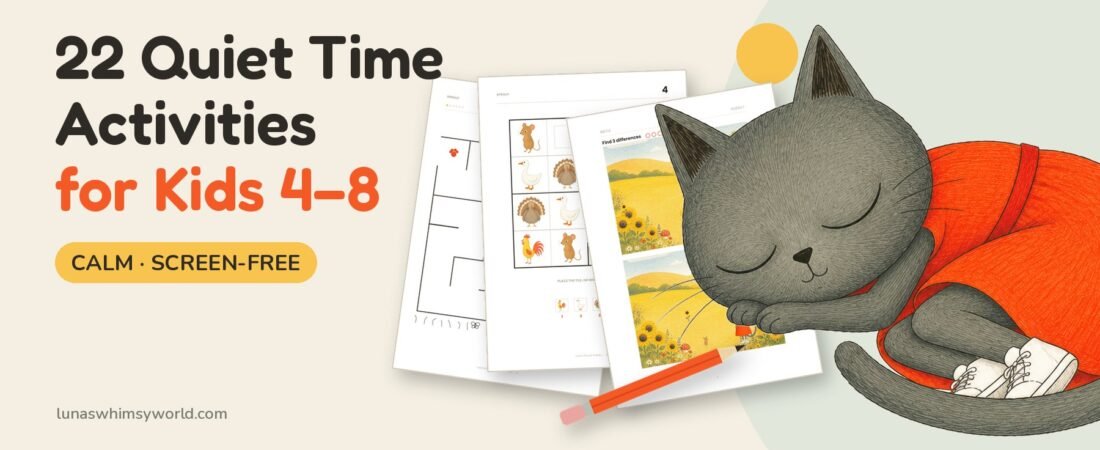
The best quiet time activities for kids aged 4 to 8 are calm, simple and possible to do alone: a maze, a picture sudoku, a story basket, a jigsaw on a tray. Keep a small basket of them ready, set a gentle timer, and an hour of quiet time becomes a normal part of the day rather than a battle.
Quiet time is what often replaces the nap once a child stops sleeping in the afternoon. It is an hour, or sometimes twenty minutes, when everyone in the house slows down. The child is not asleep, and not entertained either. They are simply doing something calm, mostly on their own.
That is harder than it sounds at four, and still a skill at eight. Good quiet time activities for kids make it easier. This guide has twenty-two ideas: six that need almost nothing, six printable pages, six hands-busy ideas from around the house, and four for listening and stories. None of them needs a screen, and none needs reading.
Luna, the little grey cat in our books, is good at quiet. She is based on a real cat. When I moved back to the Hungarian countryside, a shy, all-grey mother cat came into our garden with a family of cats and stayed with us for the rest of her life. She knew exactly how to find a sunny corner and rest. Most children need a little more help with that.
Key takeaways
- Quiet time is calm time alone, not sleep. Twenty minutes is a good start at age 4.
- Keep a quiet time basket that only comes out at quiet time, so it stays interesting.
- Picture-based puzzles suit ages 4 to 8 because nobody has to read the instructions.
- Rotate a few activities each week rather than offering everything at once.
- A visual timer or a story recording tells your child when quiet time ends, so you do not have to.
In this article
What is quiet time, and who is it for?
Quiet time is a set part of the day when a child plays calmly on their own, usually in their room or a cosy corner. It often follows lunch, in the slot where the nap used to be. It can also fit after school, before dinner on a busy day, or on a rainy afternoon when everyone is tired.
It is for the child, who gets a rest from noise and instructions. It is also for the grown-up, who gets a moment to rest, work or cook. Both are fine reasons.
Quiet time is not a punishment, and it does not have to be silent. Humming over a maze or chatting to a toy is part of it. The only rules most families need are these: stay in the quiet space, choose from the basket, and use quiet voices.
How to set up quiet time activities for kids
The setup matters more than the activities themselves. Even the best quiet time activities for kids work better in a familiar space. A child who knows where to sit, what to choose from and when it ends will settle much faster.
| Set up | Why it helps |
|---|---|
| One quiet space | A rug, a beanbag or a corner of the bedroom. The same place every day tells the body it is time to slow down. |
| A quiet time basket | Five or six activities that only come out at quiet time. Swap two of them each week. |
| A visual timer | A sand timer, a coloured light or the length of one story recording. Your child can see the end without asking. |
| A clear start | The same small signal each day: shoes off, curtains half closed, basket out. |
| A gentle end | A hug, a snack, and something to look forward to afterwards. |
Start small. Fifteen or twenty minutes is plenty for a four-year-old in the first week. Add five minutes at a time until you reach the length that suits your family. Many children aged 6 to 8 are happy with forty-five minutes to an hour, especially with a book or a long puzzle.
Quiet time activities for kids that need almost nothing
These six ideas use what is already in the house. They are good for the first days, before you have built a basket.
1. The cushion nest
Give your child a pile of cushions and a blanket and let them build a nest. Building is the activity; lying in it afterwards is the rest. Many children read or look at books in their nest without being asked.
2. Picture book looking
Children who cannot read yet can still spend a long time with picture books. Choose books with busy, detailed pictures and suggest a small mission: find every cat, every hat or every red thing.
3. Sorting a button tin
A tin of large buttons, a few small bowls and a muffin tray will keep many children busy for twenty minutes. Sort by colour, by size, or by number of holes. Use large buttons only, and leave this one out if there are younger children in the house.
4. Drawing what you can see
Give your child a clipboard and a pencil and ask them to draw one thing they can see from where they sit: the window, a toy, their own foot. Slow, close looking is a quiet skill in itself.
5. Small world play
A shoebox becomes a house, a farm or a garden with a few small figures. Small world play tends to be quiet because children talk to themselves in soft voices while they play.
6. Window watching
Pull a chair to the window with a blanket. Count the cars, birds or people with umbrellas. The American Academy of Pediatrics suggests something similar in its ideas for restful play: slowing down to notice small sounds and sights, or sharing a story together.
Printable quiet time activities for kids
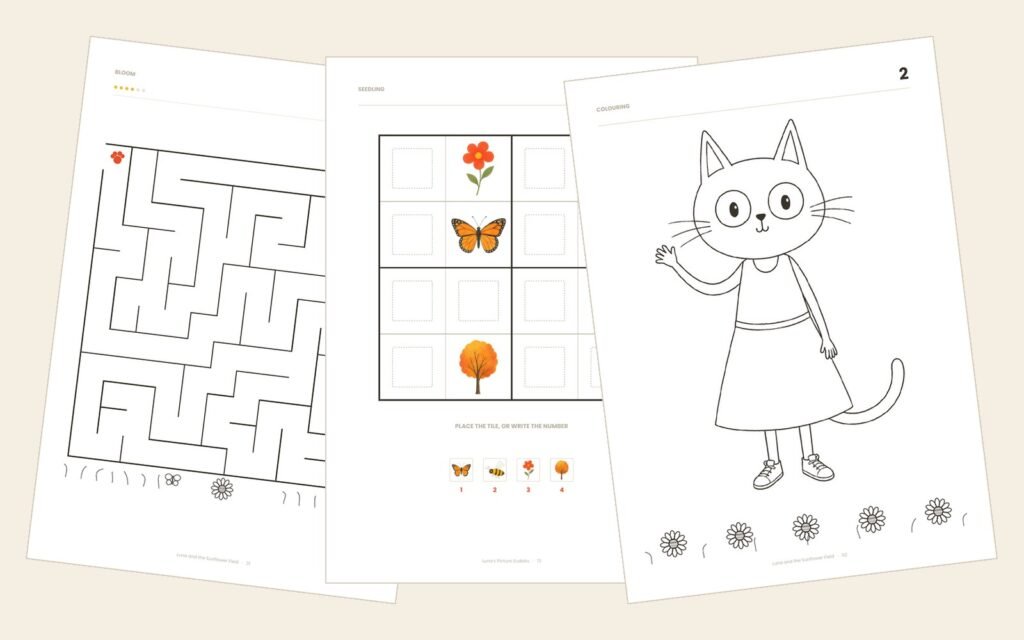
Printed pages are the easiest quiet time activities for kids to prepare. A page has a clear start and a clear finish, and your child can do it alone. Print a few at a time and keep them in a folder in the basket.
7. Mazes
Mazes are one of the calmest printable activities there is. A child traces slowly, gets stuck, goes back and tries again. Start with a small, open maze at age 4 and move to bigger grids as your child grows.
8. Picture sudoku
Picture sudoku uses pictures instead of numbers: every row and column needs one sheep, one hen, one pig and one cow. It looks like a game, and it is quiet, careful thinking. A 4×4 grid suits most 4- and 5-year-olds.
9. Spot the difference
Two pictures side by side, a handful of small changes to find. Spot the difference keeps children looking closely for a long time, and they can tick off each one they find.
10. Colouring pages
Colouring is the classic quiet activity for a reason. Choose pages with large, clear shapes for younger children. A small pot of pencils is quieter than felt tips and does not dry out when the lids get lost.
11. Look and find scenes
A busy scene and a list of things to find, shown as pictures. These suit children who like stories, because the scene often has a little story of its own.
12. A quiet time puzzle folder
Put one maze, one picture sudoku, one spot the difference and one colouring page in a folder, and let your child choose the order. Choosing gives them a sense of control, which often makes quiet time easier to accept.
Free for your quiet time basket: Luna and the Little Hello is a short picture storybook about Luna, with a one-page activity sheet to go with it. Download it free in A4 and US Letter.
Hands-busy quiet activities from around the house
Some children rest best when their hands are moving. These six ideas keep hands busy and voices low. Adult supervision recommended; small parts and scissors are for grown-up hands with children under 3.
13. Playdough on a tray
A tray keeps the dough in one place. Add a rolling pin, a plastic knife and two or three cutters, and nothing else. Fewer tools usually means longer, calmer play.
14. Threading pasta
Large tube pasta, a shoelace with tape around the end, and a bowl. Threading is slow, repetitive and very calming. Older children can make patterns: two long, one short.
15. A jigsaw on a board
A jigsaw that lives on a tray or a board can be carried in and out of quiet time without losing pieces. Twenty-four pieces suit many 4-year-olds; 100 pieces or more suit many 7- and 8-year-olds.
16. Sticker scenes
A sheet of stickers and a blank page or a simple background is a quiet activity that feels like a treat. Ask for a story when it is finished.
17. Building with blocks
Wooden blocks or interlocking bricks are quiet if they stay on a rug. A small challenge helps: build a bridge for a toy car, or a house for one figure.
18. Lacing cards
Punch holes around the edge of an old greeting card and give your child a long shoelace. Lacing cards are free to make, easy to store in the basket, and good for small hands.
Story and listening quiet time activities for kids
Listening is one of the most restful things a child can do. These four ideas work well at the end of quiet time, or on days when your child is very tired.
19. Audio stories
A story recording is both an activity and a timer: when the story ends, quiet time ends. Choose calm stories with a gentle voice, and let your child lie down while they listen.
20. A story basket
Put three or four favourite picture books in the basket with one small toy from each story. Children often act out the story quietly with the toys after they have looked at the pictures.
21. Retelling with pictures
Lay the pages of a short printed storybook on the floor out of order and ask your child to put the story back together. It is a puzzle, a story and a quiet game at once. Luna’s free storybook works well for this.
22. The quiet time journal
Give older children a small notebook for quiet time only. They can draw what they did today, what they noticed from the window, or a new picture for a story they already know.
Quiet time activities for kids by age: 4, 5–6 and 7–8
Every child is different, so treat this as a starting point. If something is too hard, go down a level; if it is finished in two minutes, go up one.
| Age | Quiet time length | Good first activities |
|---|---|---|
| Age 4 | 15–30 minutes | Cushion nest, picture book looking, small open mazes, 4×4 picture sudoku, playdough on a tray, audio stories |
| Ages 5–6 | 30–45 minutes | Mazes and spot the difference, colouring, threading, sticker scenes, look and find, story basket |
| Ages 7–8 | 45–60 minutes | Bigger mazes, 6×6 picture sudoku, 100-piece jigsaws, the quiet time journal, retelling stories, chapter books |
For more ideas sorted by situation, from the car to the café, see Luna’s page of screen-free activities for kids.
A simple quiet time routine for home days
A routine takes the arguing out of quiet time. Here is one that many families can adapt.
- Lunch, then the signal. The same small signal every day: shoes off, curtains half closed.
- Choose two. Your child picks two activities from the basket. Everything else stays in.
- Timer on. Start the sand timer or the story recording, and tell your child where you will be.
- Check in once. Halfway through, a quick look and a smile. No new instructions.
- A gentle end. When the timer runs out, a hug and a snack. Ask what they made, not whether they were good.
The same routine works on rainy days, sick days at home and quiet Sunday afternoons. On busy days out, a few of the same pages fit in a bag for the waiting room or a restaurant table.
Key tips and common mistakes
When quiet time activities for kids do not seem to work, the cause is usually one of a few small things, and they are easy to change.
- Too long, too soon. Start with fifteen or twenty minutes and build up slowly. A short quiet time that works is better than a long one that does not.
- Everything on offer. A full toy box is not restful. Five or six activities in a basket are easier to choose from.
- The same basket for months. Swap two activities each week. Old favourites feel new again after a rest.
- Puzzles that are too hard. Quiet time is not the moment to stretch. Choose a level your child can finish alone.
- No clear ending. Children who do not know when quiet time ends will keep asking. A timer or a story recording answers for you.
- Quiet time as a consequence. Keep it a calm, normal part of the day, never something that happens after trouble.
Which Luna book to use
Luna’s year-round books are full of quiet time activities for kids: calm, independent pages for ages 4 to 8. None of them needs reading, and each is an instant PDF download in A4 and US Letter, with the answers included.
- Year-Round Activity Bundle: the Sunflower Field maze book, the farm picture sudoku and Spot the Difference in one download. Enough pages for many weeks of quiet time.
- Printable Maze Book: Sunflower Field: 60 mazes from small and open to big and winding, with a Luna story and colouring pages.
- Picture Sudoku: Luna at the Farm: 60 picture sudoku puzzles with farm animals, a story and memory cards.
- Spot the Difference: Look Again: 60 spot the difference puzzles with painted Luna scenes and a story.
Start with a free story: if you would like to try Luna first, Luna and the Little Hello is free. It is a short picture storybook with an activity sheet, ready for your quiet time basket.
A grown-up note
Adult supervision recommended; small parts and scissors are for grown-up hands with children under 3. Keep buttons, pasta and other small things out of the basket if a younger brother or sister might find it.
Quiet time looks different in every home. Some children rest happily for an hour; others need you nearby, or need to move. Screens are part of many family days, and nothing here is meant to judge that. If quiet time is hard for your child right now, a shorter time, a different place or a different activity is a perfectly good answer. Adapt everything to your child.
Frequently asked questions
What are good quiet time activities for kids aged 4?
Good quiet time activities for kids aged 4 are simple and short: picture book looking, a cushion nest, playdough on a tray, small mazes, 4×4 picture sudoku and audio stories. Start with fifteen to twenty minutes.
How long should quiet time be?
Many families start with fifteen to twenty minutes at age 4 and build up slowly. Many children aged 6 to 8 are happy with forty-five minutes to an hour, especially with a long puzzle or a book.
What if my child will not stay in quiet time?
Make it shorter, make the end clear with a timer or story recording, and let your child choose two activities from the basket. Quiet time is a skill, and most children find it easier after a few weeks of the same routine.
Can quiet time replace a nap?
For many children who no longer sleep in the afternoon, quiet time takes the place of the nap. It is still a rest, just an awake one. If your child falls asleep during quiet time, that is fine too.
What should go in a quiet time basket?
Five or six calm activities that only come out at quiet time: a few printed pages in a folder, a jigsaw on a board, playdough, a story book or two, and something for busy hands. Swap two of them each week.
Do I need to print in colour?
No. Mazes and colouring pages are black line art and print well in greyscale. Every Luna book comes in A4 and US Letter; print at “Actual size” on plain printer paper.
Related reading
- Screen-free activities for kids 4–8: Luna’s quiet, take-along puzzles in one place.
- 20 Waiting Room Activities for Kids 4–8: quiet ideas for the doctor, the dentist and other waits.
- Luna’s stories: short read-aloud stories and the free Little Hello storybook.
- Meet Luna: the shy grey cat behind every page.
Closing
Quiet time activities for kids do not need to be new or clever. A cushion nest, one maze, a story on the speaker: that is enough for a calm hour. Fill a small basket, set a gentle timer, and let Luna keep your child company while the house slows down.