
The best waiting room activities for kids are quiet, fit on a lap, use your own supplies and can stop the moment a name is called. Start with games that need nothing, keep two or three printed pages for the long part, and pack one small thing for the hands.
A waiting room is a strange place for a child. The chairs are too big, the room is full of strangers, and nobody can tell you how long the wait will be. It might be four minutes. It might be forty. At a restaurant you know the food is coming; at the doctor’s, the dentist’s or a clinic, you simply wait.
So waiting room activities for kids need a slightly different shape from car games or restaurant games. They have to be small and calm, they must not need much space, and they have to stop in one move when the door opens. This guide has twenty of them: eight that need nothing at all, six with paper and a pencil, and six small things worth keeping in a bag.
Luna began as a real cat. When I moved back to the Hungarian countryside, a family of cats walked into our garden, and among them was a shy, all-grey mother cat. She was the most frightened of them all, and she stayed with us for the rest of her life. The Luna in the books is still a little shy, which is one reason her puzzles are quiet ones.
Key takeaways
- Start with a game that needs nothing. Save the paper for when the wait gets long.
- Pick activities that stop in one move: a page you can fold, a game you can pause mid-turn.
- Bring your own supplies. A small pouch is easier to stop, pack and wipe than a shared toy box.
- Go one level easier than at home. A waiting room is not the place for the hardest maze in the book.
- Restock the pouch the same day, so it is ready for the next wait.
In this article
What makes good waiting room activities for kids?
Before the list, here are six simple tests. An activity does not have to pass all of them, but the more it passes, the better it works in a room full of strangers.
| Test | Why it matters in a waiting room |
|---|---|
| Quiet | Other people may be unwell, worried or on the phone. |
| Fits on a lap | There is rarely a table, and the chairs may be close together. |
| Your own supplies | Easy to keep track of, easy to wipe, easy to pack away. |
| No small loose parts | Beads and counters roll under chairs you cannot reach. |
| Stops in one move | When the name is called, you fold the page and go. |
| Calm, not exciting | A child who is wound up before an appointment finds the appointment harder. |
Waiting room activities for kids that need nothing at all
These eight games work in the first few minutes, when you have just sat down and do not want to unpack anything yet. They also save the day when the pouch was left in the car.
1. Palm pictures
Use one fingertip to draw a shape on your child’s palm: a circle, a square, a heart. They close their eyes and guess. Then swap, so they draw on your hand. For children aged 6 to 8, draw a letter or a number. It is silent, it needs no space at all, and it is surprisingly hard to get bored of.
2. Tiny voices
Take turns saying a word as quietly as you can while the other person can still hear it. Then whisper a colour, and both of you look for something in the room that is that colour. The game turns a whispery room into part of the fun instead of a rule to obey.
3. The eyes-closed room tour
Give your child thirty seconds to look around the room. Then they close their eyes and you ask questions: what colour is the chair by the door? Is there a plant? How many windows are there? Children aged 4 and 5 can answer two or three questions; older children can take a turn asking you.
4. Hand stack
Put one hand flat on your knee. Your child puts a hand on top, then you, then them. The bottom hand slides out and goes on top, again and again, faster and faster, then slower and slower. It ends in giggles, so keep the giggles quiet.
5. Sitting statues
One person sits as still as a statue of something: a sleeping cat, a tall tree, a teapot, a snowman. The other guesses what it is. Because the statue stays seated, it suits even a small, crowded room.
6. Rhymes with cat
Say “cat” and take turns finding a rhyme: hat, mat, bat, sat, flat. When you run out, choose a new word: “bee”, “sun”, “toe”. Made-up words are allowed if they make you both smile. Children aged 4 to 6 love this one; older children can try two-syllable words.
7. Trace a slow square
Your child traces a square on their knee with one finger. Up one side, breathe in. Across the top, hold. Down the other side, breathe out. Across the bottom, rest. Four slow squares are enough. Treat it as a quiet game, not a lesson; some children like it, some do not, and both are fine.
8. The visit, step by step
Ask your child to tell you what will happen next: someone will call our name, we will walk to a room, the doctor will say hello. Fill in the gaps honestly, and keep it short. If you would like help explaining a doctor’s visit to a young child, Nemours KidsHealth has a clear guide for parents.
Paper and pencil activities for the waiting room
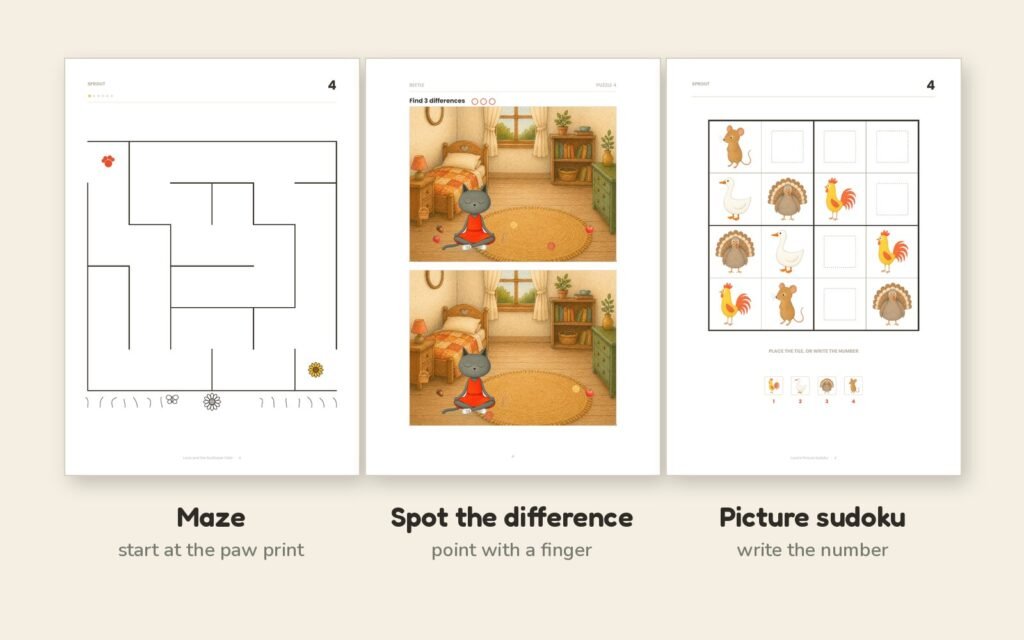
When the wait gets long, paper takes over. Of all the waiting room activities for kids I know, a single printed page on a clipboard is the most useful: it is quiet, it is flat, and when the door opens you fold it in half.
9. One maze at a time
Print one maze per wait, not a stack. A single page feels finishable, and a finished page feels good. Children aged 4 and 5 do well with small grids such as 6×6 or 8×8; 7- and 8-year-olds can manage 15×15 and up, though in a waiting room it is kind to choose a level they already know.
10. Spot the difference with tick-off circles
Spot the difference suits stop-start waits because progress is easy to keep. If the page has small circles at the top, one per difference, your child ticks a circle for each find. When the name is called, the ticks show exactly where to pick up next time.
11. Picture sudoku, written in
Picture sudoku uses pictures instead of numbers, so it works before a child can read. For a waiting room, choose the write-in version: each picture has a number, and your child writes the number in the square. No cutting, no tiles to drop.
12. Draw the room from above
Ask your child to draw a map of the waiting room as if they were a bird on the ceiling: the chairs, the door, the desk, the plant. Children aged 4 and 5 can draw one thing they can see; children aged 7 and 8 can add a dotted line for the route to the door.
13. A drawing for the doctor or dentist
Many children like making something to give away. Suggest a picture for the person they are about to see. It gives the wait a friendly purpose, and it gives a shy child something to hold out instead of having to talk first.
14. Cat and mouse noughts and crosses
Play noughts and crosses (tic-tac-toe) with a cat face and a mouse face instead of O and X. Drawing the little faces takes longer than writing O and X, which is exactly the point in a waiting room.
From the bag: six small things worth packing
These six things make waiting room activities for kids easy to carry and quick to pack away.
Adult supervision recommended; small parts and scissors are for grown-up hands with children under 3.
15. A clipboard or a hard folder
This is the most important item on the list. A clipboard turns any lap into a table, holds the page still, and keeps two pencils clipped to the top. A stiff folder works nearly as well.
16. A homemade lacing card
Cut a shape from a cereal box, punch holes around the edge (a grown-up job), and tie a long shoelace through the first hole. Your child sews in and out around the shape. It keeps hands busy without a sound, and nothing can fall off.
17. A paper fortune teller
For children aged 6 to 8, fold a paper fortune teller at home and fill it with gentle questions and tasks: “Name three animals that live on a farm.” “Tell me your favourite breakfast.” “Do your best sleepy cat face.” It travels flat and opens anywhere.
18. A waiting book
Fold four sheets of paper in half and staple them into a little book. Every wait gets one page: the date, where you were, and one drawing of something your child saw. Over the months it becomes a small diary of doctor’s visits, haircuts and dentist trips, and many children start asking for it.
19. A paper cat face
Fold a square of paper corner to corner to make a triangle. Fold the two side corners up to make ears, and fold the top point down. Your child draws a face. Three folds, one cat, and then they want to make a family of them.
20. Story cards
Cut nine small cards and draw a simple picture on each: a cat, a key, an umbrella, a cake, a boat. Your child picks three and tells a story that uses all of them. With a 4-year-old, you tell the story and they choose the cards.
Waiting room activities for kids by age: 4, 5–6 and 7–8
Every child is different, so treat this as a starting point rather than a rule.
| Age | What tends to work | A helpful tip |
|---|---|---|
| 4 | Palm pictures, rhymes with cat, sitting statues, a lacing card, 4×4 picture sudoku, small mazes | Plan one activity for every few minutes and keep it talky and hands-on. |
| 5–6 | The eyes-closed room tour, spot the difference, mid-level mazes, the paper cat face, story cards | Offer a choice of two; choosing is part of the fun. |
| 7–8 | The fortune teller, drawing the room from above, 6×6 picture sudoku, larger mazes, the waiting book | Give them a job, such as telling you when ten minutes have passed on the clock. |
Different waiting rooms, different plans
The same waiting room activities for kids work in most places, but not every wait is the same. A dentist check-up and a long hospital clinic ask for different things.
| Where you wait | What works well | What to leave for later |
|---|---|---|
| Doctor or nurse | Palm pictures, the visit step by step, one maze | Anything energetic. If your child is unwell, a cuddle and a story come first. |
| Dentist | A drawing for the dentist, rhymes with cat, spot the difference | Starting a big new activity just before you are called. |
| Hospital outpatients or a long clinic | The full pouch, swapped every ten minutes or so, plus the waiting book | Unpacking everything at once. |
| Hairdresser or barber | Mazes, story cards, a look-and-find page | Pencils near the cutting chair. |
| A brother’s or sister’s lesson | The fortune teller, picture sudoku, the waiting book as a weekly habit | The same page every week; rotate the pages. |
| A queue or a public office | Tiny voices, hand stack, the eyes-closed room tour | Paper, if you are standing. |
Whichever room it is, follow the house rules on food, drink and noise. Some clinics ask for extra quiet, and that is easier when the plan was quiet anyway.
How to pack waiting room activities for kids
A waiting pouch works best when it is always ready and only used for waits. That keeps it a little bit special.
- Choose a pouch. A zip folder or a pencil case that lives in your bag or by the door. It is only opened while you wait.
- Print four to six single pages. Mix the types: a maze, a spot the difference, a picture sudoku. Different page types last longer than four of the same.
- Print at Actual size. Choose A4 or US Letter to match your paper, and pick “Actual size” in the print window, not “Fit to page”, so the grids stay crisp.
- Use greyscale where it works. Black-and-white line art, such as maze pages, prints well on the cheapest setting.
- Add the clipboard and two pencils. One pencil will roll under a chair.
- Add one thing for the hands. A lacing card, the fortune teller or the story cards.
- Restock the same day. Take out the finished pages, put fresh ones in, and the next wait starts well.
Key tips and common mistakes
Most waiting room activities for kids go wrong in the same few ways.
- Starting with the best thing. Begin with a game that needs nothing and keep the paper for the long part of the wait.
- Choosing pages that are too hard. Waiting rooms make it harder to concentrate. Go one level easier than at home.
- Unpacking everything at once. One activity out at a time keeps the chairs tidy and the pouch interesting.
- Forgetting the stop. Everything in the pouch should stop in one move. Folding a page beats packing up thirty tiles.
- Turning the wait into a test. These activities are company, not homework. If your child would rather sit on your lap and watch the fish tank, that is a good use of the wait too.
- Leaving the pouch empty for next time. Restocking takes two minutes at home and saves a hard wait later.
A free Luna story to print: join Luna’s email list and get Luna and the Little Hello, a short read-aloud storybook with an activity sheet, in A4 and US Letter.
Which Luna book to use
Luna’s printable books make simple waiting room activities for kids: no reading needed, black-and-white puzzle pages that print well at home, and a short illustrated story in every book. Each is an instant PDF download in A4 and US Letter.
- Spot the Difference: 60 puzzles in six levels, from 3 differences up to 10. Every page has tick-off circles, so a half-finished page is easy to pick up again. All the differences are changes of shape, position or size, not colour, so it prints on the cheap greyscale setting. The bonus story is Luna Looks Again.
- Sunflower Field Maze Book: 60 mazes in six levels, from 6×6 up to 18×18, in black line art, plus nine Luna colouring outlines. The bonus story is Luna and the Sunflower Field.
- Picture Sudoku: 60 farm-picture puzzles on 4×4 and 6×6 grids. The number key is printed on every puzzle page, so the write-in version needs no cutting. It also has 12 pairs of memory cards and the story Luna and the Smallest Voice.
- Year-Round Activity Bundle: all three books together, so you can mix page types in one pouch.
In autumn and winter, the Halloween and Christmas look-and-find books add another page type; you will find them on the Halloween and Christmas activity pages. For more quiet ideas, see the screen-free activities page.
A grown-up note
Adult supervision recommended; small parts and scissors are for grown-up hands with children under 3. Punch lacing-card holes and cut story cards yourself, and keep pencils in hand with younger children.
If your child is unwell, tired or worried, the activities can wait. Comfort comes first, and a quiet cuddle is a perfectly good waiting room activity. Screens are a family decision too, and nothing here is meant to judge the families who use them.
If you would like more ideas from a professional, a paediatric occupational therapist writing for The Genius of Play suggests planning play for waits, with ideas such as I Spy bottles, card games and mess-free drawing kits. Adapt everything to your child.
Frequently asked questions
What are good waiting room activities for kids who cannot read yet?
Choose games that use pictures, hands and voices: palm pictures, rhymes with cat, sitting statues and the eyes-closed room tour. On paper, mazes, spot the difference and picture sudoku all work without reading.
What should I pack for a doctor’s waiting room with a 4-year-old?
A clipboard, two pencils, two or three easy printed pages, and one thing for the hands, such as a lacing card. Add water and a snack if the clinic allows it. Keep it small enough that you can pack it away in seconds.
How do I keep a child busy in a waiting room without a screen?
Start with a game that needs nothing, then move to one printed page, then to the item for the hands. Swapping activities every few minutes keeps the wait moving. And if your child simply wants to sit with you and watch, let them.
Should my child play with the toys in the waiting room?
That is your call. Many families use them happily. A pouch of your own has some advantages: you know what is in it, it is easy to wipe, and it packs away the moment your name is called.
How many pages should I print for a waiting room?
Four to six single pages is plenty for most waits: a mix of mazes, spot the difference and picture sudoku. For a long hospital clinic, add one or two more and the waiting book.
Do the Luna printables come in A4 and US Letter?
Yes. Every Luna book is an instant PDF download in both A4 and US Letter. Print at “Actual size” on plain printer paper.
Related reading
- 21 Quiet Restaurant Activities for Kids 4–8: the same approach for the wait between ordering and eating.
- 25 Screen-Free Travel Activities for Kids 4–8: planes, cars, airports and stations.
- 20 Christmas Puzzles for Kids 4–8: printable and homemade puzzles for December.
- Meet Luna: the shy grey cat behind every page.
Closing
Waiting room activities for kids do not need to fill every minute. They only need to make the wait a little smaller: a game on a palm, a page on a clipboard, a lacing card going in and out. Pack the pouch tonight, put it by the door, and the next wait already has a plan.