
The most useful travel activities for kids are small, quiet and matched to the seat your child is in. A plane seat has a tray table, so paper puzzles work well there. A car seat has no table and a moving view, so looking and listening games suit it better. This list gives you 25 screen-free ideas for children aged 4 to 8, sorted by where you will use them.
A journey with young children is mostly waiting: at the gate, in the queue, in the seat, in traffic. No single activity fills all of that. What helps is a handful of short things, in a sensible order, in a kit small enough to reach without standing up.
I make printable puzzle pages for children, so paper has a place among these travel activities for kids. It is not the answer everywhere, though, and I will say where I would leave it in the bag.
Key takeaways
- Choose travel activities for kids by the seat: paper for planes and trains, looking and listening games for the car.
- Pack one small pouch per child, with a few pages for each part of the trip.
- Keep one thing they have not seen before for the hardest hour.
- In the car, some children feel queasy when they look down. For them, use the window games and audio stories.
- Plan a change of activity before boredom arrives, and add movement at every stop.
In this article
How to choose travel activities for kids by where you sit
The same child needs different things in different seats. This table is the short version of the whole article.
| Where | What works | What to leave in the bag |
|---|---|---|
| Plane | Paper puzzles on the tray table, stickers, a dry-wipe pocket, drawing, audio stories with headphones | Anything with small loose pieces, anything noisy, anything that rolls |
| Car | Window games, counting games, talking games, audio stories and songs | Hard or heavy objects, and close-up paper for a child who gets car sick |
| Train or ferry | Everything that works at a table, plus the view | Things that slide when the carriage moves |
| Airport, station, queue | Standing and walking games, spotting games, stretches | Anything that needs a surface or a seat |
How to pack a travel activity kit
All the travel activities for kids in this list fit in one pouch per child, small enough to sit on a lap. A zip pouch or a large envelope is enough.
- Printed pages, sorted by leg. Four to six pages for the way there and a separate set for the way back, each in its own envelope. The return journey is when supplies usually run out.
- A pencil and three crayons. Triangular crayons do not roll off a tray table. Take a spare pencil.
- A clear sheet protector and a dry-wipe pen. One page becomes many turns.
- A sheet of dot stickers. They are flat, quiet and leave nothing behind.
- Headphones, if you are bringing audio stories.
- One small new thing. Wrapped, if you have time. Keep it for the hardest hour.
That last point has good backing. In its holiday travel tips, the American Academy of Pediatrics suggests a carry-on with crayons, colouring books, mess-free markers, books and small toys.
At airport security, the kit goes through the scanner like everything else. The US Transportation Security Administration’s page on travelling with children says children’s toys, bags and blankets are placed on the X-ray belt. Tell your child before you reach the front that the pouch will go for a short ride and come straight back.
Adult supervision recommended; small parts and scissors are for grown-up hands with children under 3.
Travel activities for kids on a plane
A plane seat is the best place for paper. There is a table, the light is good and nobody is going anywhere. These nine fit on a tray.
1. A maze in a dry-wipe pocket
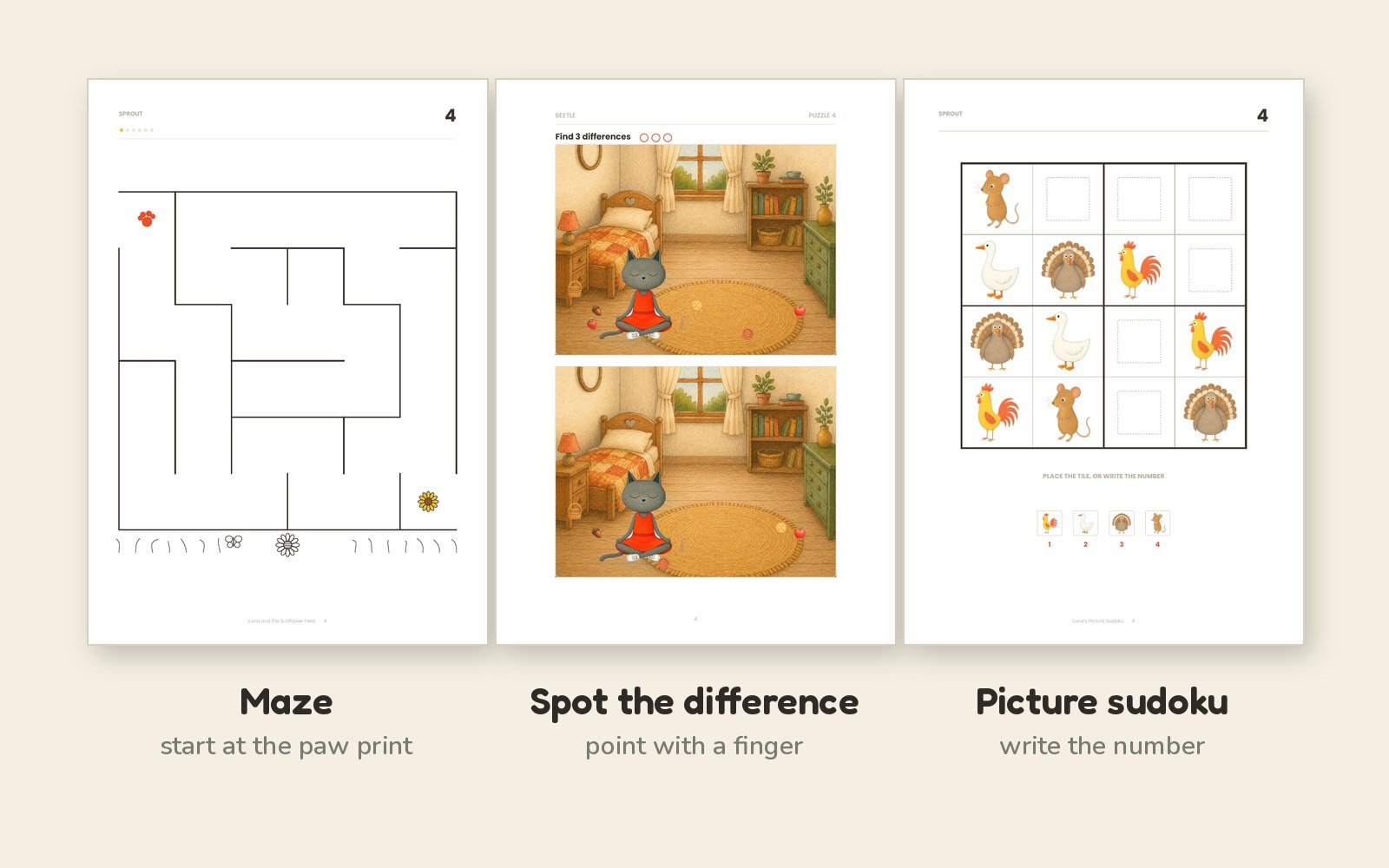
Slide a maze into the sheet protector and hand over the dry-wipe pen. A wrong turn wipes away with a tissue, so there is no rubbing out and no fresh page needed. Start one level easier than at home.
2. Spot the difference, shared
Two pictures and a finger to point with. This is a good one to do together across the armrest. Take turns to find one difference each, and let your child find the last one.
3. Picture sudoku
A four-by-four grid with animals in place of numbers suits most five- and six-year-olds, and a six-by-six grid suits older children. Choose a version where the answer is written or drawn in, so there are no tiles to lose under the seat.
4. Draw the trip
Ask your child to draw the journey as a row of pictures: our house, the car, the airport, the plane, the place we are going. Add each new part as it happens. By landing, they have a map of the day.
5. The safety card hunt
The safety card in the seat pocket is a page of pictures with almost no words. How many aeroplanes are on it? How many doors? Can you find the life jacket? It is a ready-made look-and-find, and it is already in front of you.
6. Window watching
If you have a window seat, count the other planes on the ground before take-off, look for shapes in the clouds, and watch for the first road, river or boat on the way down. If you are in the aisle, trade seats for five minutes.
7. Dot-sticker runway
Draw two long lines on a page for a runway. Your child puts a dot sticker for each light along the edges, then draws the plane. Stickers keep small fingers busy for longer than a pencil does.
8. An audio story
A story through headphones is screen-free, needs no hands and leaves the eyes free to rest. Download two or three before you leave home, and include one your child already knows and loves.
9. The small parcel
This is the one new thing from the kit. A mini notebook, a new sticker sheet, a fresh set of pages. Unwrapping it is part of the activity. Keep it for the hour when everything else has been used up.
Travel activities for kids in the car
A car seat has no table, and the view moves. Looking down at a page makes some children feel sick. The American Academy of Pediatrics’ advice on car sickness is direct: “Have her look at things outside the car, not at books or games.”
So the car list is mostly eyes-up. If your child is comfortable with paper in the car, the plane ideas work there too, with the pages on a thin card.
10. The colour car count
Choose a colour each. The first to spot ten cars in their colour wins. Pick red for the youngest player. There are always plenty of red cars.
11. I spy with colours
“I spy something green.” For children who do not know their letters yet, colours work better than first sounds. Keep to things that stay in view for a while: the sky, a jumper, the seat in front.
12. The number hunt
Find a 1 on a sign or a number plate, then a 2, then a 3, up to 10. It can take five minutes or fifty. It suits children aged 5 and over who know their numbers.
13. Picture bingo
Before you leave, draw nine things in a grid: a cow, a bridge, a tractor, a lorry, a bird, a bus. Your child marks each one as they see it. Hold up the card for a glance, so they do not need to look down for long.
14. Would you rather
Would you rather be as small as a mouse or as tall as a tree? Would you rather have wheels or wings? There are no wrong answers, and the reasons are the best part.
15. Three things
Your child names three things they can see: a crane, a dog, a yellow van. You tell a very short story that uses all three. Then swap. Their stories will make less sense than yours, and be better.
16. Songs and audio stories
Make a short list for the journey and let each person choose in turn. Audio stories work well on a long, dull stretch of road, and they are kind to a child who feels queasy.
17. The quiet minute
Who can stay silent until the next bridge? Keep it short and say when it ends. A minute of quiet that a child chooses feels very different from being told to hush.
18. Count the journey
Choose something to count for the whole trip: tunnels, bridges, tractors, wind turbines. Keep the tally on your fingers or call out the number each time. Guess the final total before you set off.
A word on what goes in the back seat. In a sudden stop, anything loose keeps moving. Safe Kids advice shared by UK HealthCare is to pack loose items in the boot and keep heavy things low. For the car, a soft pouch and a few sheets of paper are a better choice than a hard clipboard or a heavy toy.
Travel activities for kids while you wait: airports, stations and queues
Waiting on your feet is the hardest kind. These seven need no seat, no surface and nothing in your hands.
19. Follow the line
Floors in airports and stations are full of lines. Walk along one without stepping off, as far as the next pillar. It turns the walk to the gate into a game, and it keeps a child beside you.
20. Shape spotting
Find a circle, a square, a triangle and an arrow on the signs around you. Arrows are everywhere in an airport, and working out where one points is a small puzzle in itself.
21. I packed my bag
“I packed my bag and in it I put a toothbrush.” The next person repeats it and adds one thing. Three or four items is a fair round for a four-year-old. Older children will go much further than you can.
22. Find the number
Pick a number, perhaps your gate or your child’s age. How many times can you find it before you sit down? Screens, signs, shop windows and luggage tags all count.
23. Copy my beat
Tap, tap, clap, softly on your knees. Your child copies it, then makes up one for you. It is quiet, it needs no space, and it works standing in a queue.
24. Smallest and biggest
What is the smallest thing you can see from here? What is the biggest? In an airport the biggest is easy. The smallest takes real looking, and that is the point.
25. Stretch like Luna
Before a long sit, stretch like a cat. Reach up tall, curl up small, arch your back, shake out one paw at a time. Luna does this before every adventure. A minute of moving makes the next hour of sitting easier.
Travel activities for kids by age: 4, 5–6 and 7–8
Treat ages as a starting point. Tired children do best one step below their usual level.
| Age | Good choices | What helps |
|---|---|---|
| 4 | Colour car count, I spy with colours, dot-sticker runway, the easiest mazes, stretch like Luna, a familiar audio story | Short turns, lots of change, and a grown-up playing too |
| 5–6 | Number hunt, picture bingo, safety card hunt, mazes, picture sudoku on a four-by-four grid, I packed my bag | Let them choose from two things, and let them teach you the game |
| 7–8 | Would you rather, three things, count the journey, six-by-six sudoku, spot the difference with eight to ten changes | Give them the kit to look after, and the job of choosing what comes next |
Travelling with children of different ages? Take the same kind of page at two levels, so each child has their own and nobody gets the “baby” one.
A simple plan for a long travel day
With travel activities for kids, a rhythm helps more than a schedule. This is the order I would use, and then repeat.
| Stage | What to offer |
|---|---|
| Look | A window game or a spotting game, while everything is still new |
| Make | Paper, stickers or drawing, once you are settled in the seat |
| Eat | A snack, with everything else put away |
| Listen | An audio story or songs. This is the rest stage |
| Move | At every stop, queue or aisle walk: stretch, follow the line, find the number |
Change stage before your child asks to. Keep the small parcel for the point in the day you are dreading most.
Printing travel activities for kids: a short guide
- Print small sets. Four to six pages for each leg of the journey are easier to manage than a whole book.
- Check the paper size. A4 in Europe, the UK and Australia; US Letter in the United States and Canada. Every Luna file comes in both.
- Print at “Actual size”. For half-size pages, choose two pages per sheet in the print window, then cut and clip.
- Keep the hardest levels full size. Fine maze lines need the whole page.
- Print before you travel. Hotel and airport printers are rarely where you need them.
The full step-by-step is in restaurant activities for kids, which uses the same kit on a smaller scale.
Key tips and common mistakes
The usual problems with travel activities for kids are about timing and quantity, not about the activities themselves.
- Packing too much. A heavy bag of toys is hard to reach and hard to repack. A few flat things do more.
- Handing over everything at take-off. One thing at a time. The pouch stays with you.
- Forgetting the way home. Seal the return set in its own envelope and do not open it early.
- Relying on paper in the car. If your child goes quiet and pale, put the page away and look out of the window together.
- Choosing activities that need you the whole time. Mix in a few that a child can start alone, so you can rest too.
- Skipping the movement. A child who has stretched and walked sits better afterwards.
Which Luna book to use for travel
Every game in this list is free, and most need nothing. For the paper-based travel activities for kids, these are the Luna books I would print from. Each is an instant PDF download in A4 and US Letter, and no page needs reading.
- Sunflower Field Maze Book: 60 mazes in six levels, from a 6 × 6 grid up to 18 × 18. The maze pages are black line art on white, so they print cheaply and fit a dry-wipe pocket well.
- Spot the Difference: 60 puzzles, from 3 differences to 10. A row of small circles at the top of each page lets a child tick off what they have found.
- Picture Sudoku: 60 puzzles on 4 × 4 and 6 × 6 grids. The key is printed on every puzzle page, so a child can write the number and no cutting is needed.
- Year-Round Activity Bundle: all three books together, which makes it easy to mix page types in each set.
Each book includes a short illustrated Luna story to read aloud; the Stories page tells you which is which. Travelling in December? The Christmas activity books have the same puzzle types with a winter theme. The year-round books are together on the screen-free activities page.
A grown-up note
Seat belts stay fastened and car seats stay as they were fitted. No game is worth loosening a strap for. Stickers and other small items are for children aged 4 and over with a grown-up beside them.
None of this is a case against screens. A film on a long flight is a reasonable choice, and the same American Academy of Pediatrics travel tips mention screens as one option for older children. These ideas are for the hours you would like to fill another way, and for the moment the battery runs out.
Adapt everything to your child and your journey.
Frequently asked questions
What are the best travel activities for kids who cannot read yet?
Choose activities where the instruction is a picture or a spoken sentence: mazes, spot the difference, picture sudoku, dot stickers, colour-based I spy and counting games. A child aged 4 to 6 can start all of these without reading a word, which matters when you are busy with bags and boarding passes.
What should I pack to keep a 5-year-old busy on a flight?
One small pouch: four to six printed puzzle pages, a pencil, three crayons, a sheet protector with a dry-wipe pen, dot stickers, headphones for audio stories and one small new thing kept back for later. Everything in it is flat and quiet, and it fits on a tray table.
What can children do in the car if they get car sick?
Choose eyes-up activities: counting cars by colour, I spy, the number hunt, songs and audio stories. The American Academy of Pediatrics advises having a child look at things outside the car and not at books or games. Save the paper for stops and for the other end.
How many travel activities for kids do I need for a long journey?
Fewer than you think, used in a better order. For a child aged 4 to 8, plan one small set of pages for each leg, a short list of no-paper games you know by heart, some audio, and one new thing. Rotating between looking, making, eating, listening and moving matters more than the number of items.
Are screen-free travel activities realistic for a whole flight?
For some families and some flights, yes. For others, a mix works better. Many parents start with paper and games while everyone is fresh and keep a screen for later. Having both gives you more choice.
Can I print the pages in A4 and US Letter?
Yes. Every Luna book includes both sizes. Print with the file that matches your paper, at “Actual size”, and print before you leave home.
Related reading
- 21 Quiet Restaurant Activities for Kids 4–8 — table games and the full printing guide, for meals out during the trip.
- Screen-free activities for kids 4–8 — the three year-round Luna books on one page.
- Luna’s stories — short read-aloud stories for the quiet part of the journey.
Closing
Good travel activities for kids are less about what you pack and more about when you bring it out. Look out of the window first. Make something once you are settled. Eat, listen, move, and begin again. A pouch with a few pages, a pencil and one small surprise is enough to work with.
Before your next trip, print two small sets, seal one for the way home, and learn three of the no-paper games by heart. Those three will still be there when everything else has been used.