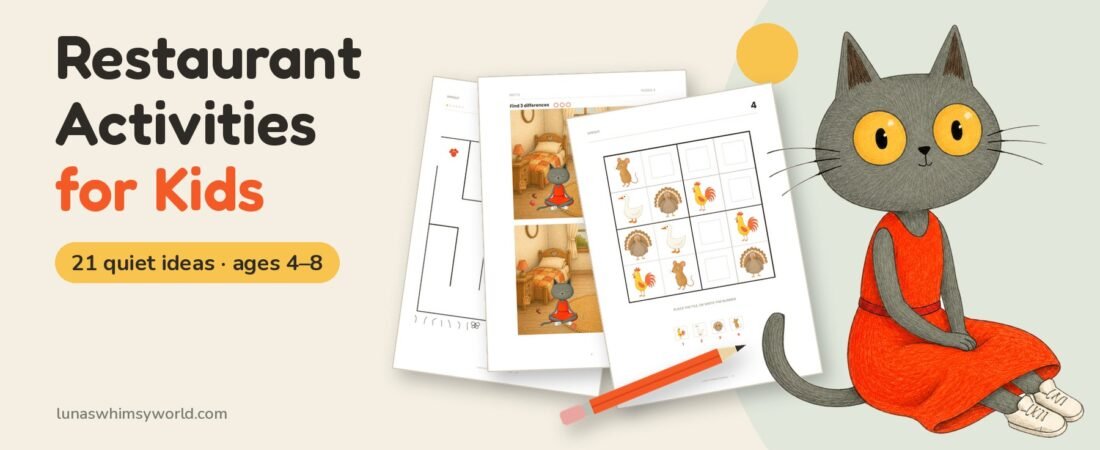
The best restaurant activities for kids are quiet, flat and small: games that need nothing but the table in front of you, a few pencil-and-paper puzzles, and one or two things from a pouch in your bag. This list has 21 of them for children aged 4 to 8. None needs reading, and every one can stop the second the plates arrive.
The hard part of a meal out is rarely the eating. It is the stretch between ordering and the food: the menus have gone, everyone is hungry, and there is nothing to do with your hands. That stretch is what these restaurant activities for kids are for.
I make printable puzzle pages for children, so this list leans towards paper and a pencil. It starts with eight games that need no paper at all, because some days you leave the house with nothing. By the end you will have a short plan for the whole meal and a kit you can pack once and forget about.
Key takeaways
- The restaurant activities for kids that work best are quiet, need little space and can be put down in one move when the food comes.
- Start with games that need nothing, and save the paper for after you have ordered.
- Pack four to six pages, not a whole book. A small choice is easier for a hungry child than a big one.
- Choose no-reading activities for children aged 4 to 6, so they can start without waiting for you to explain.
- One new thing they have not seen before is worth more than five familiar ones.
In this article
What makes good restaurant activities for kids?
A restaurant table is a small, shared, slightly sticky workspace with other people nearby. An activity that is lovely at home can be a poor fit there. These six tests sort the good ideas from the stressful ones.
| Test | Why it matters at a table |
|---|---|
| Quiet | Other tables are close. Whisper-level games and pencils are kinder than anything that beeps, rattles or rolls |
| Flat and small | You have the space of a place mat, and the bread basket is coming |
| No small loose parts | Whatever falls under the table stays there until you crawl after it |
| No mess | No glitter, no slime, no paint. A pencil and two or three crayons are enough |
| Starts without reading | A child who can begin alone gives you time to read the menu |
| Stops in one move | When the plates arrive, everything should go back in the pouch in a few seconds |
You do not need all six every time. If an idea fails the last one, though, leave it for home.
Restaurant activities for kids that need nothing at all
Begin here. These eight games use only what is on and around the table, so they work even when you have packed nothing. They also suit the first few minutes, while the grown-ups are still choosing.
1. Colour hunt
“Find three red things without leaving your seat.” Then three blue ones, then three green. For a four-year-old, pointing is enough. An older child can whisper each one to you, or try to find five.
2. Count it
How many lights can you see? How many chairs at our table, and how many windows? Counting real things in a real room is more interesting than counting dots on a page, and the answer is always different in a new place.
3. What changed?
Put three things on the table: a spoon, a napkin, a sugar packet. Your child closes their eyes while you move one or take it away. Which one? Swap roles after two turns. Children enjoy catching a grown-up out.
4. Shape spotting
Find a circle, a square and a triangle somewhere in the room. Plates and clocks are easy. Triangles are the hard ones, and the search for one can last until the drinks come.
5. Quiet ears
Close your eyes for ten slow breaths. How many different sounds did you hear? Cutlery, a coffee machine, a door, someone laughing. This is the calmest game on the list, and a good one when the table is getting loud.
6. Luna-sized
Luna, the grey cat in our stories, is about as tall as a cup. What on this table could she hide behind? What could she climb? Could she get from the salt to the window without being seen? A small imaginary friend makes any table look bigger.
7. Guess my animal
Think of an animal. Your child asks questions you can answer with yes or no: does it have four legs, does it live in water, is it bigger than me? Younger children often prefer to be the one who knows the answer.
8. One sentence each
Start a story with one sentence: “A very small cat walked into a very big kitchen.” Your child adds the next sentence, then you, then them. Stop when the food arrives, wherever the story has got to.
Pencil-and-paper restaurant activities for kids
Once you have ordered, bring out the paper. These eight need a pencil and a page. A menu or a thin card behind the page gives a firm surface if the table is uneven.
9. Mazes
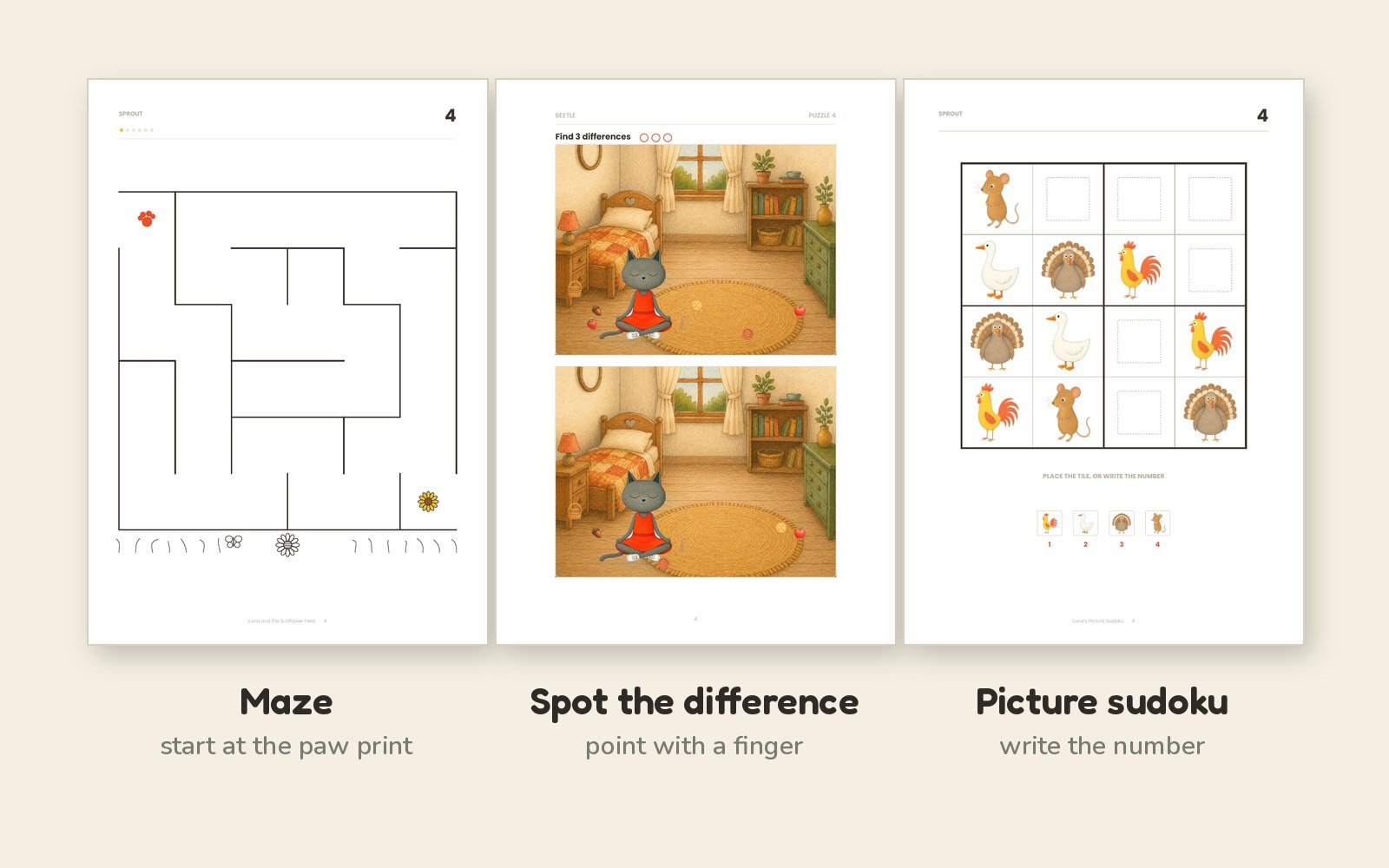
A maze has one instruction, and it is a picture: start here, finish there. A child who cannot read yet can begin alone. Choose a maze one step easier than you think they need, because a noisy room makes everything a little harder.
10. Spot the difference
Two pictures, a handful of changes, and a finger to point with. Younger children can start with three differences and older ones with eight or ten. It is a good activity to share, since two people can look at the same page without getting in each other’s way.
11. Picture sudoku
Picture sudoku uses animals or objects in place of numbers. Each picture appears once in every row and every column. A four-by-four grid suits most five- and six-year-olds. Use the kind where a child writes or draws the answer, so there are no tiles to slide off the table.
12. Draw the other half
Fold a page in half and draw half of something along the fold: half a butterfly, half a heart, half a house. Your child finishes the other side. It takes you ten seconds to set up and them several minutes to complete.
13. Squiggle swap
One person draws a squiggle. The other turns it into something: a snail, a hat, a road. Then swap. There is no wrong answer, which makes it a kind choice for a child who dislikes getting puzzles “wrong”.
14. Dots and boxes
Draw a grid of dots, four by four to start. Take turns joining two dots with a line. Whoever closes a square writes their initial in it and goes again. It suits ages 6 to 8, and a full game fits neatly into the wait for a main course.
15. Draw your dinner
Ask your child to draw what they ordered before it arrives. When the plate comes, compare the two. Was the pizza that round? Were there that many chips? It gives the waiting a point, and it ends by itself.
16. A maze for your grown-up
Draw a start and a finish on a blank page and hand over the pencil. Your child builds the walls, and you have to solve it. Their mazes will be gloriously unfair. Solve them anyway, and look worried while you do it.
From the kit: five small things worth packing
These five restaurant activities for kids live in a zip pouch in your bag. Adult supervision recommended; small parts and scissors are for grown-up hands with children under 3.
17. Dot stickers
A sheet of plain dot stickers and a piece of paper. Children can make a caterpillar, a traffic light or a pattern, or put a dot on every circle you draw. They peel quietly and leave nothing behind.
18. Memory cards
Six pairs of picture cards are enough for a game on a small table. Lay them face down, turn two at a time, and keep the pairs you match. For a four-year-old, start with three pairs and play face up.
19. Pipe cleaners
Three or four pipe cleaners bend into glasses, a crown for a spoon, letters or a spiral snake. They make no noise, do not roll and can be straightened out for next time.
20. A dry-wipe pocket
Slide a puzzle page into a clear sheet protector and add a dry-wipe pen and a tissue. One page now lasts the whole meal, and the next meal as well. It is the single most useful thing in the pouch.
21. A story for the last five minutes
Keep one short story folded in the kit, to read quietly when the plates have gone and you are waiting to pay. A story gives a tired child something to listen to when they have run out of doing.
Restaurant activities for kids by age: 4, 5–6 and 7–8
Ages are a rough guide. Go by what your child enjoys and how tired they are, and step down a level when you are out. Easy and finished feels better than hard and abandoned.
| Age | Good choices | What helps |
|---|---|---|
| 4 | Colour hunt, count it, Luna-sized, dot stickers, the easiest mazes, spot the difference with three changes | Sit beside them, point together, and keep each activity short |
| 5–6 | What changed?, shape spotting, mazes, picture sudoku on a four-by-four grid, draw the other half, memory cards | Let them start alone, then ask them to show you how they did it |
| 7–8 | Guess my animal, dots and boxes, harder mazes, spot the difference with eight to ten changes, a maze for your grown-up | Give them the pencil and the choice of what comes next |
With children of different ages, bring the same kind of page at two levels. A four-year-old and an eight-year-old can both do a maze, and nobody feels they were handed the baby one.
A simple plan for the whole meal
Restaurant activities for kids work better with a little timing. This is the order I would use.
- Before you leave. Print one small set of pages and check the pouch. Tell your child where you are going and that the kit is coming too.
- While you choose. Play one or two no-paper games. Order as soon as you can.
- After you order. Now the paper comes out. Offer two pages and let your child pick.
- When the food arrives. Everything goes into the pouch in one move.
- After eating. A no-paper game or the folded story, while you wait to pay.
The American Academy of Pediatrics makes similar points in its guide to eating out with young children. It suggests arriving early, ordering the whole meal promptly and bringing crayons, a few books or quiet toys, and it notes that toys a child has not seen before work especially well. In its words, “Boredom and impatience are not your friends.”
The same guide points out that sitting through a restaurant meal is a skill children learn with practice. A meal that goes badly is simply a practice that went badly.
How to print restaurant activities for kids so they fit in your bag
A whole activity book is too much to carry and too much to choose from. Print a small set.
- Choose four to six pages. Mix the types: a maze, a spot the difference, a picture sudoku and a blank page for drawing.
- Use the right paper size. A4 in Europe, the UK and Australia; US Letter in the United States and Canada. Our files come in both.
- For full-size pages, print at “Actual size”. Fold the set in half and it fits in most bags.
- For half-size pages, print two per sheet. In the print window, look for “Multiple” or “Pages per sheet” and choose 2. Cut down the middle and clip the pages together.
- Keep the hardest levels full size. The easier levels stay clear at half size. The trickiest mazes have fine lines that need the whole page.
- Print in black and white if you like. Line-art puzzle pages lose nothing in greyscale.
- Add a pencil, two crayons and a clip. That is the whole kit.
To use a page more than once, slip it into the dry-wipe pocket from idea 20.
Key tips and common mistakes
Most problems with restaurant activities for kids come from timing, not from the activities themselves.
- Bringing everything out at once. One activity on the table at a time. The rest stays in the pouch, where it is still a surprise.
- Starting too hard. A level that is fine at home can be too much in a noisy room. Go one step easier.
- Packing things that roll. Round crayons, marbles and toy cars leave the table. Triangular crayons and flat things stay put.
- Saving the best for later. If the first ten minutes go well, the rest usually follows. Lead with the favourite.
- Explaining for too long. Choose activities a child can see how to do. Pictures make better instructions than sentences.
- Forgetting the end. Keep one small thing back for the wait for the bill.
A free Luna story to print: join Luna’s email list and get Luna and the Little Hello, a short read-aloud storybook with an activity sheet, in A4 and US Letter.
Which Luna book to use
Every idea above works with a blank page and a pencil. If you would like ready-made restaurant activities for kids, these are the Luna books I would print from. Each is an instant PDF download in A4 and US Letter, and no page needs reading.
- Sunflower Field Maze Book: 60 mazes in six levels, from a gentle 6 × 6 grid up to 18 × 18. Start at the paw print, finish at the sunflower. The maze pages are black line art on white, so they print well in greyscale.
- Picture Sudoku: 60 puzzles on 4 × 4 and 6 × 6 grids with farm animals in place of numbers. There are two ways to play, and the write-the-number way needs no cutting. The book also has 12 pairs of memory cards, which covers idea 18.
- Spot the Difference: 60 puzzles, from 3 differences to 10. No difference is a change of colour alone, so every page works in black and white.
- Year-Round Activity Bundle: all three books in one download, for when you would like to mix page types in every set.
Each book comes with a short illustrated Luna story to read aloud, which takes care of idea 21. You can read about them on the Stories page, and see all three books side by side on the screen-free activities page.
A grown-up note
Stickers, pipe cleaners and small cards are for children aged 4 and over with a grown-up at the table. If a younger brother or sister is with you, keep those in the pouch and stay with the pencil-and-paper ideas.
This list is not an argument against screens. Some meals need a tablet, and that is your decision to make. If you would like to set your own family rules, the American Academy of Pediatrics offers a free Family Media Plan tool. The ideas here are simply there for the days you would like another option in your bag.
Adapt everything to your child. There is no wrong way to play any of these.
Frequently asked questions
What are good restaurant activities for kids who cannot read yet?
Choose activities where the instruction is a picture: mazes, spot the difference, picture sudoku, dot stickers and drawing games. Games that need no paper, such as a colour hunt or counting the lights, work for non-readers too. A child who can start without help is busy sooner and stays busy longer.
What should I pack in a restaurant activity bag?
A zip pouch with four to six printed pages, a pencil, two or three crayons, a clip, a sheet of dot stickers and a clear sheet protector with a dry-wipe pen. That is enough in the way of restaurant activities for kids aged 4 to 8 to cover a whole meal, and it is small enough to stay in your bag between outings.
How do I keep a 4-year-old busy at a restaurant without a screen?
Keep each activity short and sit close. Start with a pointing game such as a colour hunt, move to stickers or an easy maze after you have ordered, and change activity before they ask to. Several small things in a row usually work better than one long one at this age.
Is it all right to use a tablet at a restaurant?
That is for each family to decide. Many parents keep a screen as a backup and try something quiet first. The activities in this article are an option to have ready, not a rule about screens.
Can I print the pages in black and white?
Yes. Mazes and picture sudoku are line-based puzzles and print clearly in greyscale. In the Luna spot-the-difference book, no difference depends on colour alone, so those pages work in black and white as well.
Do the printable pages come in A4 and US Letter?
Yes. Every Luna book includes both paper sizes. Choose the file that matches the paper in your printer and print at “Actual size”, not “Fit to page”.
Related reading
- Travel Activities for Kids: 25 Screen-Free Ideas for Planes and Cars — the same approach for longer waits: flights, car rides and airports.
- Screen-free activities for kids 4–8 — the three year-round Luna books on one page.
- Meet Luna — the small grey cat in an orange dress behind every page.
Closing
Restaurant activities for kids do not need to be clever. They need to be quiet, small and ready before you sit down. Eight games that need nothing, a few printed pages and a pouch with a pencil in it will carry most children aged 4 to 8 from the menu to the main course.
Start small. Print four pages tonight, put them in a zip pouch with a pencil, and leave the pouch in your bag. The next time the food takes twenty minutes, you will already have something to reach for.